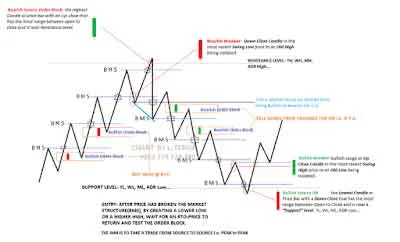
This page collects notes around ICT-style order block concepts and frames the PDF as a study resource for traders who want to understand how these zones are described, classified, and reused in a broader market-structure workflow. It is strongest when treated as terminology and concept revision, not as a standalone shortcut.
What This Resource Covers
- A working description of an order block as a price area or candle used to frame institutional participation.
- Basic classifications such as bullish and bearish order blocks.
- The difference between a source order block, breaker, and continuation order block.
- A glossary of related terms including FVG, BMS, OTE, RTO, and imbalance language.
- Compiled study credits that point back to the note sources referenced on the page.
How The Notes Frame Order Blocks
According to the notes on this page, an order block is meaningful because traders use it as a decision area rather than just another candle pattern. The page also highlights what happens when an order block fails: once violated, it may be treated as a breaker and watched differently on a retest.
Who This PDF Is For
This resource is most useful for traders already exploring ICT or related smart money terminology. If you are new to order blocks, the glossary and classification list can help you understand the language before moving on to more chart-heavy practice.
How To Study It
- Read the terminology list first so the abbreviations make sense on the chart.
- Separate bullish, bearish, breaker, and continuation examples in your own notes.
- Replay charts and mark where a zone holds, where it fails, and how structure changes afterward.
- Use the PDF as a study reference, then compare it with other order-block pages on the site.
Pros
- The page gathers several order-block concepts in one place.
- The glossary makes it easier to follow related ICT discussions.
- It can serve as a useful bridge between basic definitions and deeper chart study.
Limitations
- This material is terminology-heavy, so it still needs chart practice to become useful.
- Some concepts are introduced briefly and work better as part of a larger study path.
- The PDF should complement risk management and execution rules rather than replace them.
Related Resources
- Tradable vs Non-Tradable Order Blocks
- Part 1: What is an Orderblock
- Market Makers Method (Order Blocks) English PDF
- Inner Circle Trader ICT Full Videos
If order blocks are already part of your vocabulary, this page works best as a clean revision guide that helps you organise the main concepts before you test them on live charts.